Learn about DMARC, SPF, and DKIM
Welcome to DMARCPal's Learn blog. Check our posts to discover and learn more about DMARC, SPF, DKIM, and how to get the most value of your DMARCPal subscription.

You publish a DMARC record with a valid rua address. Mail still reaches Microsoft 365, but the aggregate reports never arrive. Then you move the MX record back to Microsoft 365 and reports begin appearing again.
That behavior is usually not caused by a malformed DMARC record or a broken report m...

An RFC 7489 DMARC aggregate-report parser can appear to work after the DMARC specification moves on. It still finds feedback, record, source_ip, and policy_evaluated. The danger is that it silently loses the meaning of newer reports: a namespace check fails, a policy-discovery field is ignor...

Moving from p=none to enforcement is a meaningful change. Aggregate reports may show that most mail is authenticated, but a small forgotten application, forwarding path, or seasonal sender can still be important.
DMARC has a test-mode tag for this situation: t=y. It lets a domain owner publish...

Most DMARC subdomain advice starts with sp. That tag is useful, but it treats every subdomain without its own DMARC record as one group. A domain that exists in DNS and a name that does not exist at all are not always the same security decision.
The np tag, introduced by RFC 9989, gives doma...

An authentication-failure report can be useful seconds after a message fails. It can also be a forged email carrying hostile MIME, a privacy-sensitive copy of somebody else's message, or the first packet in a denial-of-service campaign.
That combination makes ARF automation a security design probl...

It is tempting to put every complaint signal into one spreadsheet column:
complaints / messages sentThat shortcut is the reason many deliverability reports appear to contradict one another. Gmail Postmaster Tools, Yahoo's Complaint Feedback Loop (CFL), and other Abuse Reporting Format (ARF) fee...

A Gmail Postmaster Tools graph that falls to 0% looks like good news. Sometimes it is. But if Gmail messages are simultaneously disappearing from the inbox, the zero may be describing who got to report the message, not the quality of delivery to the whole audience.
This is one of the most dang...

Gmail Postmaster Tools is useful only when Gmail can connect the messages it receives to the domain you added. That sounds obvious, but it is the reason many otherwise legitimate senders see empty charts, missing authentication data, or a persistent No data found status.
The domain in the visibl...

Rotating an SMTP certificate is usually a routine maintenance task. Rotating a certificate on a DANE-protected MX is different because the certificate and the DNS TLSA record are two halves of the same authentication decision.
Change the service first and a sender with cached TLSA data can reject...

DANE can make inbound SMTP resistant to certificate substitution and STARTTLS downgrade attacks. It can also turn a small DNS or certificate mistake into a growing queue of delayed mail.
That is not a reason to avoid DANE. It is a reason to deploy it as a mail-routing change, not as a single TLS c...

July is the point where many email programs discover that their Q3 campaign plan is more ambitious than their sending setup.
The DNS records look familiar. The sending platform says authentication is enabled. The campaign team has an unsubscribe link in the footer. Then a new audience, a new subdo...

Spam complaint rate is no longer a metric to review after a campaign has gone wrong. In 2026, it is an operating limit.
Google's current sender guidance tells senders to keep the spam rate reported in Postmaster Tools below 0.10% and avoid ever reaching 0.30% or higher. Yahoo's bulk-sender req...

One-click unsubscribe is still the requirement that teams most often think they have covered when they actually have not.
That sounds strange at first, because by 2026 this is not new guidance anymore. Gmail and Yahoo have both been clear for a while:
- Gmail bulk senders must support one-clic...

When Gmail rejects a legitimate message for header size, the first wrong assumption is usually that the message body must be too large.
Often it is the opposite. The body can be normal. The attachments can be small. The failure is in the metadata wrapped around the message.
Google now documents...

When Gmail returns 5.7.24, the surprising part is usually this: the domain does have an SPF record, the record may even be syntactically valid, and mail can still get slowed down or blocked anyway.
That is because 5.7.24 is not the same signal as "no SPF" or "SPF failed."
Google's SMTP err...

When a printer, scanner, badge system, alarm panel, ERP, PSA, or random "notification appliance" sends mail as example.com, the problem is almost never the visible From: header by itself. The problem is what happens underneath it.
DMARC only passes when the From: domain aligns with either:...

Secure email gateways sit in an awkward place in mail flow. They inspect, rewrite, wrap, detonate, banner, and sometimes re-route messages for good security reasons. But those same changes are exactly what can make SPF fail, DKIM fail, and then DMARC fail at the final receiver.
That is why admins...

When Outlook.com starts throttling, junking, or blocking a sender, the instinct is usually to ask Microsoft for delisting immediately.
That is understandable, but it is often the wrong first move. Microsoft is fairly clear about the order of operations: follow the published policies, fix authentic...

Moving outbound mail to a new IP is one of the easiest ways to damage a healthy stream by accident.
The new IP starts cold. The old IP may still be carrying the reputation that keeps your important traffic stable. If you swing all mail over at once, mailbox providers do not see a careful migration...

When mail starts slowing down, landing in Junk, or getting rate-limited at Outlook.com, many teams look at SPF, DKIM, and DMARC first. That is still the right first pass, but it is often not enough. Microsoft's own sender tooling is where the investigation becomes practical.

Cross-domain DMARC reporting looks simple on paper: point rua= or ruf= at another domain, publish one TXT record, and wait. In real deployments, this is one of the easiest ways to end up with a technically valid-looking DMARC record and no reports at all.
The reason is that several details hav...

Moving email from one provider to another is rarely just an account migration. The visible mailbox may stay the same, but the mail path, signing system, bounce domain, sending IPs, feedback loops, tracking links, and reputation history often change underneath it.
That is why teams get surprised by...

Internationalized domain names are where otherwise careful email-auth setups get tripped by representation details.
The domain is valid. The DNS zone exists. The sender can even be signing and publishing the right policy. But one system is handling the domain as Unicode, another expects the ASCII...

When a receiver sees two From: header fields in one message, the problem is not subtle. The message is malformed.
That matters because modern receiver filtering does not separate "syntax hygiene" from "sender trust" as neatly as administrators often expect. If the visible author identity is malf...

Moving DNS to a new provider looks harmless right up until mail starts failing from systems that nobody remembered were coupled to the old zone.
That is the real risk. Email authentication is not just one TXT record at the apex. It is usually a chain of dependencies across SPF includes, DKIM selec...

Forwarding breaks SPF for a very simple reason: the server delivering the message to the final recipient is no longer the original sender.
That means the receiving system checks the forwarder's IP address against the original MAIL FROM domain, and the answer is often spf=fail even though the o...

When Gmail returns 421 4.7.28, the useful question is not just "why was this message deferred?" but which sending identity did Gmail decide was moving too fast?
That distinction matters because Google can rate limit this error at more than one layer during warm-up:
- the sending IP address
- t...

Changing outbound MTAs is one of those jobs that looks infrastructure-only right up until deliverability falls over. The new server accepts mail, queues it, and opens SMTP sessions just fine, but receivers do not care that the migration ticket says "successful". They care whether the new path is s...

Gmail's newer sender-requirement enforcement changed the operational question for many teams.
It is no longer enough to say, "SPF and DKIM are configured somewhere, so delivery should be fine." Google now gives senders a dedicated Compliance status dashboard in Postmaster Tools that is meant t...

The first few DMARC aggregate reports usually feel harmless.
Then a domain starts sending more mail, more receivers participate, forwarding paths multiply, and suddenly the rua mailbox turns into an operations problem instead of a reporting checkbox.
At that point the question is not "how do w...

Sometimes a message gets rejected, deferred, or heavily spam-foldered and the first assumption is "SPF broke" or "DMARC is failing again."
That assumption is often wrong.
Large receivers increasingly treat message formatting defects as sender-trust problems because badly formed mail is common...

Warm-up is really a trust-building exercise.
The technical side matters, but the bigger question mailbox providers are answering is simple: does this sender look predictable, wanted, and well-controlled as volume increases?
That is why teams sometimes publish SPF, DKIM, and DMARC correctly, the...

If a domain moves to p=quarantine or p=reject before it knows every legitimate system using its visible From domain, the breakage is usually self-inflicted.
That is the real reason to spend time in p=none first. It is not because monitoring feels safer in the abstract. It is because DMARC...

If bulk email compliance work is already underway, one-click unsubscribe is usually where teams discover that a footer link is not the same thing as a provider-recognized unsubscribe flow.
That distinction matters now.
Google's Email sender guidelines require bulk senders to support one-click...

If ARC headers still look like random noise during an incident, that is normal.
Most teams first care about ARC when a forwarded message is obviously legitimate, but DMARC still fails somewhere downstream. At that point, reading cv=, i=, d=, and s= quickly is what separates a five-minute d...

When DMARC fails, the DNS record is often blamed first.
In practice, the fastest path to the real cause is usually the message header, specifically the Authentication-Results line. That one line tells you what the receiver believed about SPF, DKIM, and DMARC at evaluation time.
If this still f...

Sometimes DMARC reports need to go somewhere other than the domain in the From address. That is common when reports are collected by a shared mailbox, a central security team, or an external processor such as DMARCPal that receives and organizes reports. DMARC allows that, but only after the destina...

At some point every DMARC rollout hits this exact moment:
"The DNS record is published... now what?"
The answer is reporting. Specifically aggregate DMARC reports (rua) sent as XML files.
This is where DMARC stops being a checkbox and becomes operations: figuring out who is sending as exa...

DMARC reporting is where the whole thing stops being theoretical.
If DMARC is the policy you publish in DNS, DMARC reports are the receipts: mailbox providers telling you what they observed when mail claiming to be from example.com hit their systems.
Those reports are what let you answer que...

DMARC gets talked about like a single switch you flip for a domain.
In reality, most domains are a small ecosystem:
- the apex (
example.com) where people type addresses and expect mail to "just work" - a handful of subdomains used for actual sending (
news.example.com,billing.example.com,...

It only takes one look at a real DMARC record to realize why people hesitate.
p, sp, pct, rua, ruf, fo, ri, rf...
It's not hard once it clicks. It's just that every tag looks equally important when you're new to it, and DNS is an unforgiving place to experiment.
This is a fiel...

If you've ever stared at a DMARC report thinking "but SPF is passing... why is DMARC failing?", you've already met identifier alignment.
Alignment is one of those things that sounds like an academic detail until it bites you in production. Then it becomes the entire story.
In DMARC terms, what...

This is a continuation post covering a process to setup DMARC on active domains. Visit A (sane) DMARC setup process for busy email domains to know more about this post series.
Mistakes can happen.
An updated DKIM selector record may be missing a semicolon. Someone in a rush could mistype t...
This is a continuation post covering a process to setup DMARC on active domains. Visit A (sane) DMARC setup process for busy email domains to know more about this post series.
In the previous steps of the 5-Stages DMARC Setup process we got to know more about the domain email traffic pattern...
This is a continuation post covering a process to setup DMARC on active domains. Visit A (sane) DMARC setup process for busy email domains to know more about this post series.
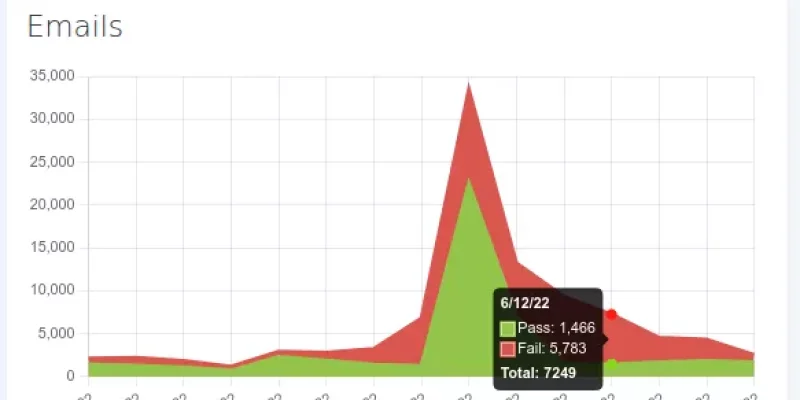
Depending on the volume of emails you send, how old your domain is, and how much exposure it has, your DMARC reports...

This is a continuation post covering a process to setup DMARC on active domains. Visit A (sane) DMARC setup process for busy email domains to know more about this post series.
The objective of this stage is to collect data so we get to know how email from the domain flows and, in parallel, m...
This is a continuation post covering a process to setup DMARC on active domains. Visit A (sane) DMARC setup process for busy email domains to know more about this post series.
Planning and controlling the DMARC deployment process is crucial to avoid problems and questions down the road that...

This is a continuation post covering a process to setup DMARC on active domains. Visit A (sane) DMARC setup process for busy email domains to know more about this post series.
Here is a brief overview of the DMARC setup process we will be covering in this post series:
The 5-Stages DMARC Se
...
DMARC is great. It allows you to publish your email sending policies, and those are used to prevent phishing emails using your domain. On top of that, it also provides reporting facilities that give you insights on your email delivery.
Implementing DMARC on new domains is straightforward. You just...